

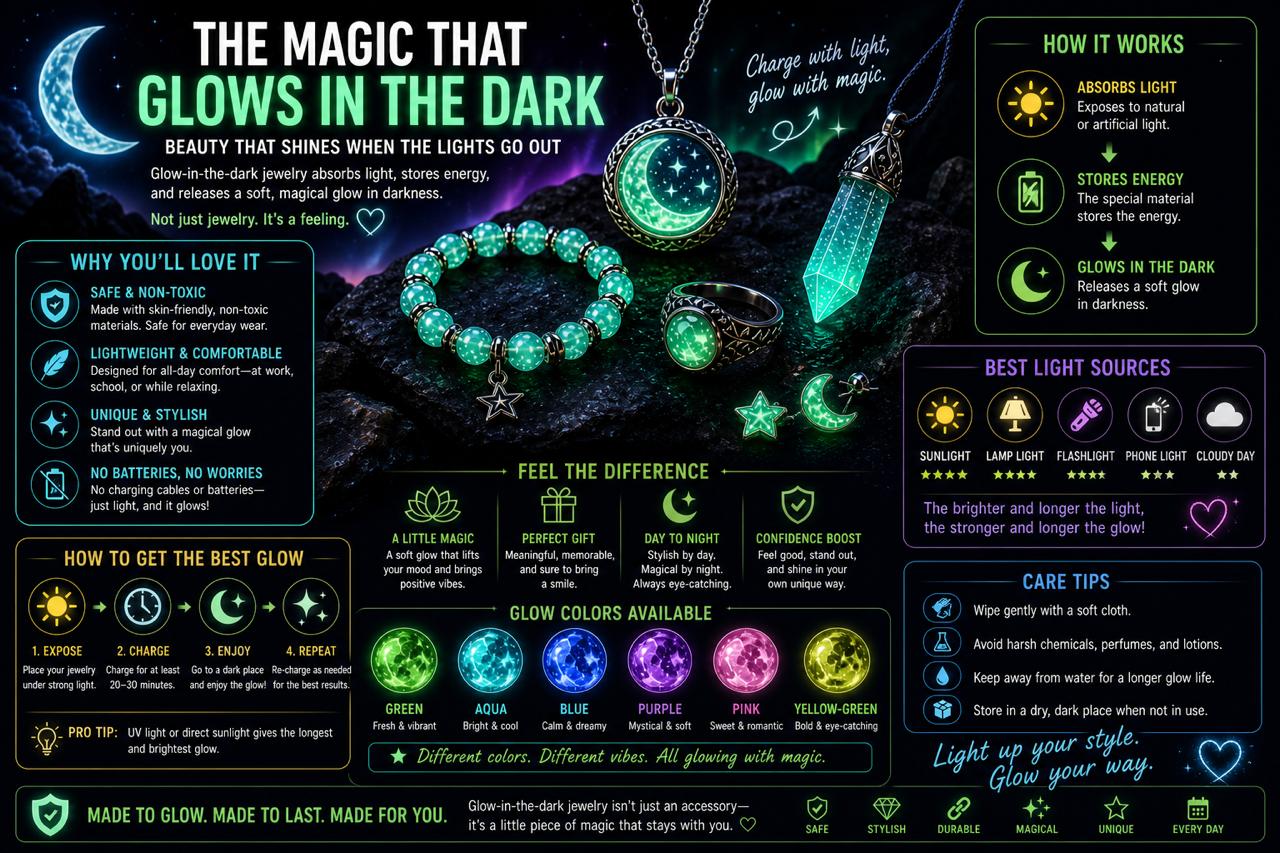
Glow-in-the-dark jewelry is fun, mysterious, and eye-catching. A necklace, bracelet, earrings, ring, pendant, mask, or accessory can look stylish during the day and reveal a soft luminous glow when the lights go down.
But because glow jewelry feels unusual, many buyers have questions before choosing their first piece. Does it need batteries? Is it radioactive? Should it glow all night? Is it the same as LED jewelry? Can you wear it every day?
Some of these questions come from real confusion. Glow-in-the-dark jewelry, LED jewelry, and UV-reactive accessories are often mixed together, even though they work in different ways.
This guide clears up the most common glow-in-the-dark jewelry myths so you know what to expect before buying luminous accessories for festivals, raves, Halloween, cosplay, concerts, camping nights, glow parties, or everyday style.
Why Do Glow-in-the-Dark Jewelry Myths Exist?
Glow-in-the-dark jewelry creates an effect that regular jewelry does not. It absorbs light, stores energy, and then glows in darkness. Because of that, people sometimes expect it to behave like an electronic light, a flashlight, or a neon sign.
The truth is simpler: most classic glow-in-the-dark jewelry uses luminous material that charges from light and releases a soft glow in dark spaces.
Many myths happen because buyers confuse three different product types:
| Type | How It Works | What to Expect |
|---|---|---|
| Glow-in-the-dark jewelry | Absorbs light and glows after darkness | Soft glow that fades gradually |
| LED jewelry | Uses electronic lights | Bright light, usually battery-powered |
| UV-reactive jewelry | Reacts under blacklight | Bright under UV, may not keep glowing after |
Once you understand the difference, glow jewelry becomes much easier to choose and enjoy.
Myth 1: Glow-in-the-Dark Jewelry Is Radioactive
This is one of the biggest myths.
Modern glow-in-the-dark jewelry is generally made with non-radioactive luminous materials. The confusion comes from old radium-based luminous products, such as some antique watch dials and instruments from the early 1900s. Those antique items are not the same as modern glow jewelry. The U.S. Environmental Protection Agency explains that glow-in-the-dark paint today is made without radioactive material, while older products once used radioactive materials such as radium.
What Buyers Should Know
Modern glow-in-the-dark jewelry is not supposed to glow because of radiation. It usually glows because of photoluminescent material that absorbs light and releases it slowly in the dark.
The bigger buyer concerns are usually normal jewelry concerns, such as:
- Skin sensitivity
- Metal allergies
- Small parts
- Sharp edges
- Product quality
- Whether the piece is age-appropriate
If you are buying modern luminous jewelry from a regular accessory shop, the glow effect itself should not be confused with antique radium-based products.
Myth 2: All Glowing Jewelry Works the Same Way
Not all glowing jewelry is the same.
Some pieces are true glow-in-the-dark jewelry. Some are LED jewelry. Some are UV-reactive accessories. They may all look “glowy,” but they behave differently.
Glow-in-the-Dark Jewelry
Glow-in-the-dark jewelry absorbs light and then glows in darkness. It usually does not need batteries.
LED Jewelry
LED jewelry uses small electronic lights. It usually needs batteries, a switch, or USB charging.
UV-Reactive Jewelry
UV-reactive jewelry looks bright under blacklight or UV light, but it may not keep glowing after the UV light is removed.
What Buyers Should Know
Before buying, check whether the item is described as:
- Glow-in-the-dark
- LED light-up
- UV-reactive
- Blacklight-reactive
- Battery-powered
These words matter because they tell you what kind of glow experience to expect.
Myth 3: Glow-in-the-Dark Jewelry Needs Batteries
Most classic glow-in-the-dark jewelry does not need batteries.
It charges from light. That light can come from sunlight, UV light, a bright lamp, or another strong light source. After charging, the jewelry releases that stored energy as a glow.
In simple words:
Light charges the jewelry → the jewelry stores energy → it glows in the dark
What Buyers Should Know
If a piece needs batteries, it is usually LED jewelry, not traditional glow-in-the-dark jewelry.
Glow jewelry is popular because it is:
- Lightweight
- Simple to use
- Easy to recharge
- Comfortable for long events
- Free from switches and wires
- Great for festivals, Halloween, cosplay, and everyday outfits
If you want a soft luminous effect without electronics, choose glow-in-the-dark jewelry. If you want flashing or very bright light, LED jewelry may be more suitable.
Myth 4: Glow Jewelry Should Be as Bright as LED Jewelry
Glow-in-the-dark jewelry is not supposed to shine like LED jewelry.
LED jewelry creates direct electronic light. Glow-in-the-dark jewelry creates a softer, more natural luminous effect. It is meant to add atmosphere and style, not act like a flashlight.
What Buyers Should Know
A good glow piece should be visible in a dark or low-light setting after it has been charged. But it should not be expected to light up a room.
Glow jewelry is best for:
- Soft magical effects
- Celestial outfits
- Halloween details
- Festival looks
- Rave accessories
- Cosplay accents
- Night photos
- Unique everyday style
For the brightest glow effect, choose jewelry with larger luminous areas, such as glow necklaces, bracelets, masks, or larger pendants.
Myth 5: Glow-in-the-Dark Jewelry Glows Forever From One Charge
Glow-in-the-dark jewelry does not glow forever after one charge.
It is usually brightest right after charging, then gradually fades as it releases stored energy. This is normal.
What Buyers Should Know
If your jewelry becomes dim, it is usually not broken. It likely needs to be recharged.
To refresh the glow, place it under:
- Direct sunlight
- UV light
- A bright lamp
- A strong flashlight
The stronger the light source, the better the glow usually appears.
Myth 6: Any Light Source Charges Glow Jewelry Equally
Not all light sources charge glow jewelry the same way.
Dim room light may only create a weak glow. Direct sunlight or UV light usually gives a stronger result.
| Light Source | Charging Strength | Best Use |
|---|---|---|
| Direct sunlight | Very strong | Best pre-event charge |
| UV light | Very strong | Parties, raves, blacklight events |
| Bright lamp | Medium to strong | Indoor charging |
| Phone flashlight | Medium | Quick boost |
| Dim room light | Weak | Soft glow only |
What Buyers Should Know
If your glow jewelry looks weak, try charging it under a stronger light before assuming something is wrong.
For festivals, Halloween events, concerts, cosplay, or glow parties, charge your jewelry shortly before wearing it.
Myth 7: Glow Jewelry Only Works Under Blacklight
Glow-in-the-dark jewelry does not only work under blacklight.
True glow-in-the-dark jewelry can charge under different light sources and continue glowing after the light is removed. Blacklight or UV light can make the glow stronger, but it is not always required.
What Buyers Should Know
There is an important difference:
| Product Type | Under UV Light | After UV Light Is Removed |
|---|---|---|
| Glow-in-the-dark jewelry | Charges and may look brighter | Continues glowing for a while |
| UV-reactive jewelry | Looks bright under UV | May stop glowing quickly |
If you want jewelry that continues to glow after the lights go off, look for true glow-in-the-dark pieces.
Myth 8: If It Stops Glowing, It Is Broken
A glow piece that stops glowing is often not broken. It may simply need more light.
Glow-in-the-dark jewelry releases stored energy over time. Once that energy is used, the glow fades. Recharging usually brings the glow back.
What Buyers Should Know
Before replacing your jewelry, try this simple test:
- Wipe the glow surface gently.
- Place the jewelry under sunlight, UV light, or a bright lamp.
- Make sure the luminous area faces the light.
- Move it into a completely dark room.
- Check the glow immediately.
If it glows after a strong charge, the jewelry is working normally.
Myth 9: All Glow Colors Are Equally Bright
Glow color can affect how bright jewelry appears.
Green and aqua tones often look brighter to the human eye. Blue can look softer and more dreamy. Purple and pink glow effects can be beautiful, playful, or romantic, but they may appear less intense than green or aqua.
What Buyers Should Know
Choose glow color based on the effect you want.
For stronger visibility, choose:
- Green glow
- Aqua glow
- Yellow-green glow
For a softer aesthetic, choose:
- Blue glow
- Purple glow
- Pink glow
A softer glow color does not mean the jewelry is bad. It may simply be designed for a more subtle look.
Myth 10: Bigger Glow Always Means Better Jewelry
A bigger glow is not always better. It depends on where and how you plan to wear the piece.
Large glow accessories are great for parties, festivals, Halloween, and cosplay. Smaller glow earrings, rings, and pendants are better for everyday style or subtle outfits.
What Buyers Should Know
Choose based on the occasion:
| Occasion | Best Glow Style |
|---|---|
| Everyday wear | Small necklace, earrings, ring, pendant |
| Festival | Necklace, bracelet, layered pieces |
| Halloween | Glow mask, pendant, ring, bracelet |
| Cosplay | Character-matching glow accents |
| Rave or glow party | Bright accessories and layered jewelry |
| Gift | A piece that looks good in daylight and glows at night |
The best glow jewelry is the piece that matches your style, not always the biggest or brightest one.
Myth 11: Glow-in-the-Dark Jewelry Is Only for Kids
Glow jewelry can be fun for children, but it is definitely not only for kids.
Many glow-in-the-dark pieces are designed for adults and teens who enjoy creative fashion, festival looks, celestial jewelry, Halloween outfits, cosplay, gothic style, fantasy aesthetics, and unique accessories.
What Buyers Should Know
Glow jewelry can look:
- Magical
- Elegant
- Romantic
- Gothic
- Futuristic
- Cute
- Mysterious
- Festival-ready
- Minimalist
A small glow pendant can be subtle enough for daily wear. A glow bracelet can look casual. Glow earrings can feel stylish and playful. Glow masks and larger accessories can be saved for events.
Myth 12: Glow Jewelry Is Always Safe for Every Child
Glow-in-the-dark jewelry can be fun, but not every piece is suitable for children.
Some jewelry has small parts, beads, charms, clasps, or loose components. For young children, small parts can create choking, ingestion, or aspiration hazards. The U.S. Consumer Product Safety Commission states that children’s products intended for children under 3 that present small-parts hazards are banned hazardous substances.
What Buyers Should Know
For children, choose age-appropriate jewelry and supervise use.
Avoid giving young children jewelry that:
- Has small detachable parts
- Can break easily
- Has sharp edges
- Contains long cords
- Can be chewed
- Has an unsecured battery compartment
Glow jewelry should be treated as an accessory, not a toy for babies or toddlers.
Myth 13: LED Jewelry Is Always Safer Because It Is Brighter
Brightness does not automatically mean safer.
LED jewelry can be fun and very visible, but it often uses batteries. If a light-up accessory contains button or coin batteries, extra care is needed around children. The CPSC warns that swallowed button or coin batteries can cause severe injury and can burn through a child’s throat or esophagus in as little as two hours.
What Buyers Should Know
Classic glow-in-the-dark jewelry usually does not need batteries. That makes it simpler for many buyers.
If you choose LED jewelry, check that:
- The battery compartment is secure.
- Batteries are not accessible to children.
- The piece is not damaged.
- It is kept away from water unless marked water-resistant.
- It is used according to product instructions.
Glow-in-the-dark jewelry and LED jewelry can both be safe when used properly, but they have different safety considerations.
Myth 14: Skin Reactions Come From the Glow Effect
If jewelry irritates your skin, the glow effect may not be the reason.
Skin reactions are often connected to metals, coatings, or materials that touch the skin. Nickel is a common jewelry-related allergen, and the American Academy of Dermatology advises people with nickel allergy to choose jewelry carefully, including nickel-free or hypoallergenic options.
What Buyers Should Know
If you have sensitive skin, check for:
- Nickel-free materials
- Hypoallergenic descriptions
- Stainless steel
- Titanium
- Sterling silver
- Comfortable earring posts
- Smooth surfaces
Remove any jewelry that causes itching, redness, swelling, burning, or rash.
Myth 15: Glow-in-the-Dark Jewelry Is Waterproof
Not all glow-in-the-dark jewelry is waterproof.
Some pieces may handle light moisture, but many should be kept away from water. Water, soap, chlorine, saltwater, perfume, lotions, and cleaning products can damage jewelry finishes, coatings, adhesives, chains, and clasps.
What Buyers Should Know
Unless the product specifically says it is water-resistant, remove glow jewelry before:
- Showering
- Swimming
- Bathing
- Entering a hot tub
- Heavy exercise
- Applying perfume or lotion
Keeping your jewelry dry helps it stay beautiful longer.
Myth 16: Glow Jewelry Can Replace Safety Lights
Glow-in-the-dark jewelry can make you more noticeable in the dark, but it should not replace proper safety equipment.
It is a fashion accessory first. It is not a flashlight, bike light, headlamp, emergency lamp, or reflective safety device.
What Buyers Should Know
For night walking, camping, cycling, hiking, or emergencies, use proper safety gear such as:
- Flashlights
- Headlamps
- Bike lights
- Reflective clothing
- Lanterns
- Safety markers
Glow jewelry is great for style and visibility accents, but it should not be your main safety light.
Myth 17: Glow Jewelry Is Hard to Care For
Glow-in-the-dark jewelry is usually easy to care for.
Most pieces only need simple habits: keep them dry, store them safely, avoid harsh chemicals, clean them gently, and recharge them with light before wearing.
What Buyers Should Know
Basic care tips:
- Store jewelry in a pouch or box.
- Wipe it with a soft cloth after wearing.
- Avoid water unless the piece is water-resistant.
- Keep it away from perfume and harsh chemicals.
- Charge it under sunlight, UV light, or a bright lamp.
- Do not bend, crack, or scratch the glow surface.
Good care helps your jewelry stay attractive and glow properly.
Myth 18: Glow Jewelry Only Looks Good in the Dark
Good glow-in-the-dark jewelry should look good in daylight too.
The glow effect is special, but the design still matters. A necklace, bracelet, earrings, ring, or pendant should match your outfit even before it starts glowing.
What Buyers Should Know
Look for pieces that fit your personal style:
- Moon and star shapes for celestial outfits
- Hearts for romantic style
- Crystals for fantasy looks
- Minimal pendants for everyday wear
- Bold accessories for festivals
- Glow masks for Halloween and cosplay
- Bracelets for casual party style
The best glow jewelry has two moods: stylish in the day, luminous at night.
Myth 19: All Glow-in-the-Dark Jewelry Is the Same Quality
Glow jewelry quality can vary. Some pieces glow clearly after charging, while others may be faint or fade quickly.
The difference can come from:
- Luminous material quality
- Size of the glowing area
- Glow color
- Jewelry construction
- Surface coating
- How well the piece charges
- Whether it is true glow-in-the-dark or only UV-reactive
What Buyers Should Know
Before buying, look for clear product information and choose a design that matches your expectations.
If you want a stronger glow, choose:
- Larger pendants
- Glow necklaces
- Glow bracelets
- Glow masks
- Layered accessories
- Green or aqua glow tones
If you want subtle style, choose:
- Small earrings
- Rings
- Delicate pendants
- Charms
- Softer glow colors
Myth 20: You Do Not Need to Charge Glow Jewelry Before Wearing It
Glow-in-the-dark jewelry needs light exposure before it glows.
If it has been stored in a drawer, box, bag, or shipping package, it may not glow immediately. That does not mean it is defective.
What Buyers Should Know
Before wearing glow jewelry to an event:
- Charge it under direct sunlight, UV light, or a bright lamp.
- Make sure the glow surface faces the light.
- Test it in a dark room.
- Recharge it if the glow looks weak.
- Wear it in a dark or low-light space for the best effect.
Charging is part of the glow jewelry experience.
Buyer’s Checklist: What to Look for Before Buying Glow Jewelry
Before choosing glow-in-the-dark jewelry, ask these questions:
| Question | Why It Matters |
|---|---|
| Is it true glow-in-the-dark or LED? | Helps you understand whether it needs batteries |
| Is it UV-reactive only? | It may only shine under blacklight |
| What type of piece is it? | Necklaces, bracelets, earrings, and masks glow differently |
| Is the glowing area large or small? | Larger areas usually look more visible |
| What color does it glow? | Some colors appear brighter than others |
| Is it comfortable? | Important for daily wear and long events |
| Is it age-appropriate? | Especially important for children |
| Is it skin-friendly? | Helpful for sensitive skin |
| Does it look good in daylight? | Makes the piece more wearable |
| How should it be cared for? | Helps the jewelry last longer |
Best Glow Jewelry Pieces for Beginners
If you are new to luminous jewelry, start with a piece that is easy to wear and easy to style.
Glow-in-the-Dark Necklaces
A glow necklace is one of the best beginner choices. It is visible, stylish, and easy to pair with many outfits.
Best for:
- Festivals
- Halloween
- Date nights
- Concerts
- Cosplay
- Glow parties
- Everyday style
Internal link suggestion: Add a link to your glow-in-the-dark necklaces category.
Glow Bracelets
Glow bracelets are great for movement. They stand out when you dance, wave, walk, or take photos.
Best for:
- Raves
- Parties
- Concerts
- Camping nights
- Festival outfits
- Group looks
Internal link suggestion: Add a link to your glow bracelets category.
Glow-in-the-Dark Earrings
Glow earrings create a softer effect near the face. They are perfect for people who want luminous jewelry without a bold statement piece.
Best for:
- Everyday outfits
- Night events
- Halloween looks
- Cosplay
- Cute party style
- Photoshoots
Internal link suggestion: Add a link to your glow earrings category.
Glow Masks and Accessories
Glow masks and larger accessories are best for dramatic looks. They are ideal for Halloween, cosplay, festivals, raves, masquerade parties, and themed events.
Internal link suggestion: Add a link to your glow masks or glow accessories category.
How to Get the Best Glow From Your Jewelry
To make glow-in-the-dark jewelry perform better, follow these simple tips:
- Charge it under strong light.
- Use sunlight or UV light when possible.
- Keep the glow surface facing the light.
- Test it in complete darkness.
- Clean the surface gently.
- Keep hair or clothing from covering it.
- Choose larger glow areas for stronger visibility.
- Layer multiple pieces for festivals or parties.
- Recharge it when the glow fades.
- Store it safely after wearing.
Small steps can make a big difference in how bright your jewelry looks.
Final Thoughts
Glow-in-the-dark jewelry is surrounded by many myths, but the truth is simple. Modern glow jewelry is usually battery-free, rechargeable with light, and designed to create a soft luminous effect in dark spaces. It is not the same as LED jewelry, it does not glow forever from one charge, and it should not be expected to shine like a flashlight.
For buyers, the most important thing is knowing what type of glow you want. Choose a glow necklace, bracelet, earrings, ring, pendant, mask, or accessory based on your style, occasion, comfort, and brightness expectations.
For festivals, raves, Halloween, cosplay, concerts, camping nights, glow parties, and everyday outfits, glow-in-the-dark jewelry can be a fun and memorable way to add light to your look.
Charge it well, wear it in the right setting, care for it properly, and enjoy the glow.
FAQ: Glow-in-the-Dark Jewelry Myths
Is glow-in-the-dark jewelry radioactive?
Modern glow-in-the-dark jewelry is generally not radioactive. Most modern glow materials are non-radioactive and charge from light.
Does glow-in-the-dark jewelry need batteries?
Most classic glow-in-the-dark jewelry does not need batteries. It charges from sunlight, UV light, or bright indoor light.
Why is my glow jewelry not glowing?
It may need stronger charging, more darkness, or a better light source. Try charging it under direct sunlight or UV light, then test it in a dark room.
Does glow-in-the-dark jewelry glow all night?
Usually no. It glows brightest after charging and then gradually fades. You can recharge it with light.
Is glow-in-the-dark jewelry the same as LED jewelry?
No. Glow jewelry charges with light and usually has no batteries. LED jewelry uses electronic lights and usually needs batteries or charging.
Is UV-reactive jewelry the same as glow-in-the-dark jewelry?
No. UV-reactive jewelry shines under blacklight, but it may not keep glowing after the UV light is removed. True glow-in-the-dark jewelry continues to glow for a while after charging.
What glow color is brightest?
Green and aqua glow colors often appear brighter. Blue, purple, and pink can look softer and more decorative.
Can I shower with glow-in-the-dark jewelry?
It is better to remove glow jewelry before showering unless the product specifically says it is water-resistant.
Is glow jewelry safe for kids?
It depends on the child’s age and the design of the jewelry. Avoid small parts for young children and supervise use.
Can glow-in-the-dark jewelry be worn every day?
Yes. Many glow necklaces, bracelets, earrings, rings, and pendants can be worn daily if they are comfortable, skin-friendly, and cared for properly.
Suggested Internal Links
- Glow-in-the-dark necklaces
- Glow bracelets
- Glow-in-the-dark earrings
- Glow rings
- Glow masks
- Glow accessories
- Festival jewelry
- Halloween accessories
- Cosplay accessories
- Gift ideas
 Previous Post
 Next Post