

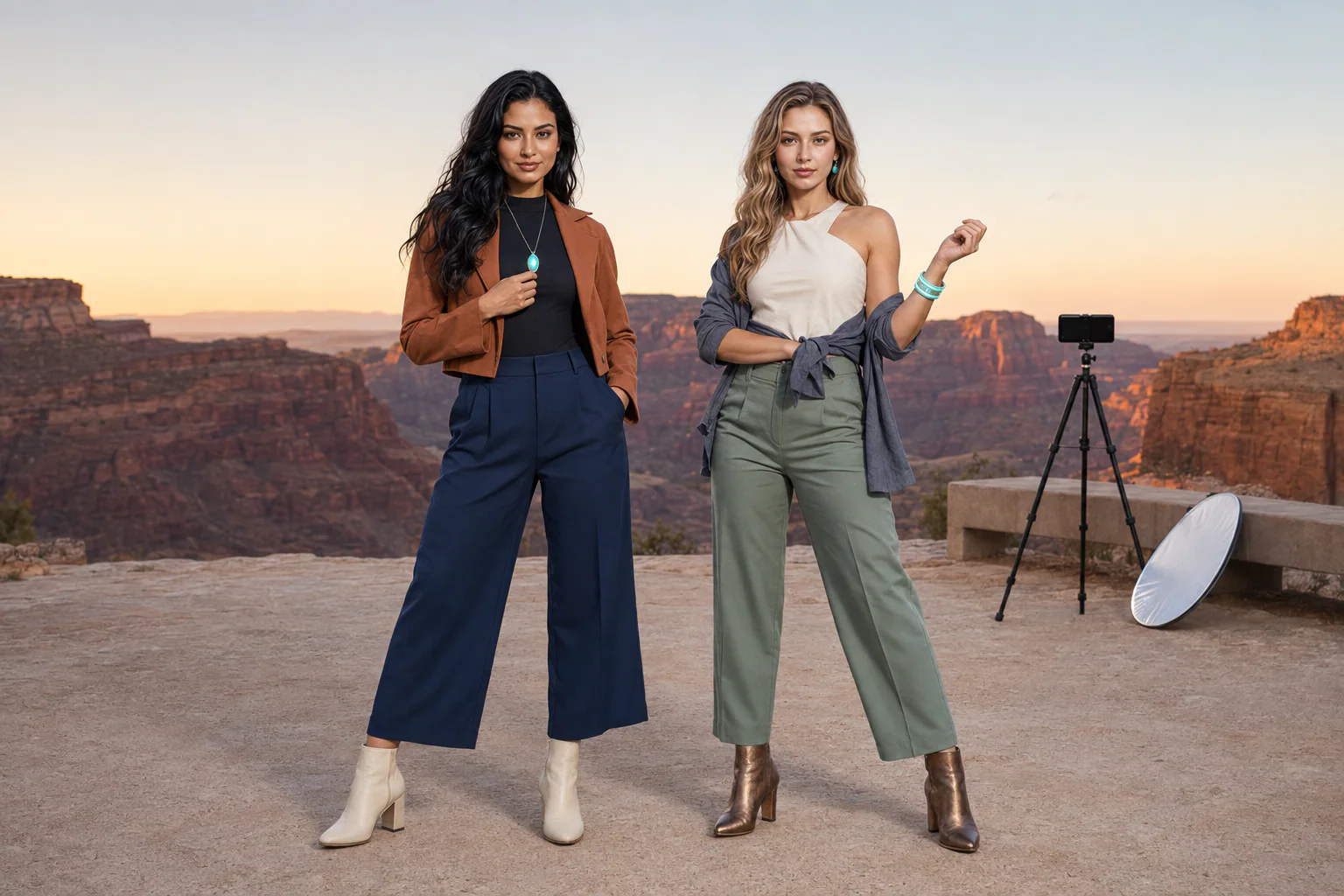
Desert festivals are built for transformation, but the camera is often less forgiving than the mood. A necklace that looks magical in your bedroom mirror can disappear against a patterned top at golden hour. A bracelet that feels dramatic in a close-up product photo can become visual noise once dust, denim, skin tone, sun glare, and stage lights enter the frame.
That is why the best way to choose festival jewelry is not only to ask, "Is this cute?" It is to ask, "Will this still read as intentional in the photos I am likely to take?"
The photo test is a simple method for building stronger night festival style before you ever arrive. It helps you choose pieces that work across desert conditions: hard afternoon light, warm sunset, blue-hour shadows, blacklight moments, flash photos, moving crowds, and the very real possibility that your outfit will look different after six hours outside.
For LUMINOUS SHOP customers, this matters because luminous jewelry, glow festival accessories, and glow-in-the-dark jewelry are especially sensitive to context. Their effect is not just about the object itself. It depends on charging, darkness, nearby lighting, camera settings, distance, styling contrast, and how the piece sits on the body.
This guide explains how to test festival jewelry like a stylist, not a shopper scrolling in a hurry.
Quick Answer
To know whether festival jewelry will work at a desert festival, test it in four photo conditions: daylight, sunset, low light, and flash. Check whether the piece has a clear shape, enough contrast against your outfit, comfortable movement, and a visible role in the look. For night festival style, choose one strong luminous detail rather than several competing pieces, and remember that decorative glow is soft, variable, and not a substitute for safety lighting.
Why Festival Jewelry Looks Different In Desert Photos
Desert settings exaggerate contrast. The light can be painfully bright during the day, gold and flattering near sunset, then suddenly flat or chaotic once artificial lighting takes over. Your jewelry has to survive all of those shifts.
A piece may fail in photos for reasons that have nothing to do with whether it is beautiful in person:
| Photo Problem | Why It Happens | Better Choice |
|---|---|---|
| The piece disappears | Low contrast against clothing or skin | Choose a clearer silhouette or brighter finish |
| The outfit looks cluttered | Too many small accessories compete | Pick one focal piece and simplify the rest |
| Glow is barely visible | Not enough darkness, weak charge, or competing lights | Test glow in a darker room and read product notes |
| Flash looks harsh | Reflective surfaces bounce light unpredictably | Use one reflective or luminous accent, not several |
| The detail sits awkwardly | Chain length, bracelet size, or mask fit is wrong | Check dimensions before ordering |
This is especially important for festival-ready luminous pieces because their visual value often appears in transition: when the sun drops, when the camera flash fires, when a friend captures a candid, or when the crowd turns under moving stage light.
The Four-Part Photo Test
The photo test does not require a studio. You need your planned outfit, your phone camera, one bright light source, one darker room, and a few minutes of honesty.
1. Daylight Test
Put on the outfit in the brightest natural light you can access. Stand near a window or outside, then take a full-body photo and a waist-up photo.
Ask:
- Can I identify the jewelry immediately?
- Does it have enough contrast against the fabric?
- Does the shape look intentional from a distance?
- Does it compete with sunglasses, hats, belts, or bag straps?
- Does it look like part of the outfit, or like a last-minute add-on?
For desert festivals, daylight is not a minor condition. It may be the first and longest environment your outfit lives in. Even if your main goal is night festival style, your look still needs to make sense before sunset.
If a necklace only works in a close-up, it may not be the anchor piece. If earrings vanish behind hair, they may still be useful, but they should not carry the outfit. If a bracelet is the strongest element in daylight, style your sleeves and hand accessories around it.
2. Sunset Test
Sunset is where many desert festival accessories become more interesting. Warm light softens skin, metallic finishes become richer, translucent pieces pick up color, and luminous details begin to feel more atmospheric.
Take photos during warm indoor light if you cannot test at sunset. A lamp placed slightly to the side can approximate some of the shadow and warmth.
Look for:
- Edges that remain readable
- Materials that do not turn muddy or dull
- Jewelry placement that flatters your face, collarbone, hands, or waist
- A focal point that still looks deliberate when the background gets busy
This test often reveals whether the piece has enough personality. Some jewelry is pretty in a product image but too quiet in a real outfit. Other pieces become more cinematic as the light drops.
3. Low-Light Test
This is the key test for glow festival accessories and glow-in-the-dark jewelry.
First, read the product description. Some pieces are glow-in-the-dark, some are UV-reactive, some are reflective, some are LED-based, and some are simply luminous in color or finish. These are not the same. A glow-in-the-dark piece may need exposure to light before it emits a soft glow. A UV-reactive piece may respond under blacklight but not in ordinary darkness. Reflective materials need light hitting them. LED pieces require power and usually have different care requirements.
Then test the item in a darker room.
Ask:
- Does the glow appear at the distance where photos will be taken?
- Is it soft and decorative, or bright enough to become the main visual point?
- Does the piece need charging before it performs?
- Does the glow fade quickly or stay visible long enough for photos?
- Does it look better alone or near another accessory?
Be realistic. Decorative glow jewelry is not a flashlight, safety device, or emergency visibility tool. It may look beautiful in dark pockets of a venue, but it can be overwhelmed by stage lighting, phone flash, LED walls, fog, dust, and distance. The honest goal is not guaranteed brightness. The goal is a memorable visual accent that supports the outfit.
4. Flash Test
Phone flash changes everything. It can flatten texture, reveal awkward gaps, exaggerate shine, and make a delicate accessory either pop or vanish.
Take one mirror photo with flash and one photo from a few feet away. If possible, ask someone else to take a candid-style shot while you move.
Check:
- Does the jewelry create a clean point of interest?
- Does flash make the piece look cheap, harsh, or distracting?
- Does the accessory sit where the camera naturally looks?
- Does your face still remain the strongest part of the image?
- Does the piece photograph better from one angle than another?
The flash test is particularly useful for luminous jewelry because a piece that looks subtle in real life may become stronger in a photo, while another piece may lose its charm under direct light.
What Makes Jewelry Photo-Ready For Night Festival Style
Photo-ready jewelry has a job. It is not just decoration. It creates a visible relationship between the body, the outfit, and the environment.
For night festival style, the best pieces usually have at least three of these qualities:
| Quality | Why It Matters |
|---|---|
| Clear silhouette | The camera can read the shape quickly |
| Strong placement | The piece sits near the face, hands, neckline, or movement line |
| Contrast | It separates from skin, hair, and clothing |
| Motion | It catches light when you walk or dance |
| Comfort | It stays wearable long enough to be photographed naturally |
| Context fit | It suits dust, heat, crowds, and changing light |
The strongest festival jewelry does not need to shout. It needs to hold its shape under pressure.
Choose One Visual Anchor
The biggest mistake in festival styling is trying to make every accessory the main event. A glowing necklace, dramatic earrings, stacked bracelets, reflective belt, face gems, metallic bag, and statement sunglasses may all be interesting separately. Together, they can flatten into visual clutter.
Choose one anchor:
- A luminous necklace near the collarbone
- A glowing bracelet stack that appears in dance photos
- Earrings that frame the face after sunset
- A mask or face accessory for a more editorial look
- A ring or hand detail for close-up photos
Then let the rest of the outfit support that anchor.
If you want the accessory to carry your night festival style, place it where cameras naturally land. Necklaces and earrings work well for portraits. Bracelets and rings work well for drink, dance, and hand-detail photos. Masks and face pieces are more dramatic but require careful fit and comfort checks.
Match Jewelry To The Outfit Texture
Desert festival outfits often involve mesh, crochet, denim, metallic fabric, fringe, utility pieces, swimwear-inspired layers, sheer materials, and boots. Jewelry has to either contrast with that texture or intentionally echo it.
Use this simple pairing guide:
| Outfit Texture | Jewelry Direction | Why It Works |
|---|---|---|
| Crochet or mesh | Smooth luminous detail | Prevents the look from becoming too busy |
| Denim or utility fabric | Glow or metallic accent | Adds night energy to practical texture |
| Metallic clothing | Softer luminous jewelry | Avoids too much hard shine |
| Sheer layers | Clean pendant or bracelet | Keeps the styling legible |
| Fringe or movement | Minimal necklace, stronger earrings | Lets motion stay readable |
| All-black outfit | One bright or glowing focal point | Creates contrast without overdesign |
This is where desert festival accessories become strategic. The goal is not to cover yourself in theme pieces. The goal is to make one choice look inevitable.
Test The Distance, Not Just The Close-Up
Product photos are usually close. Festival photos are often not.
A friend may take your picture from six feet away. A crowd shot may capture you from the waist up. A night photo may blur slightly. A video may catch the jewelry only when it moves.
So test three distances:
| Distance | What It Reveals |
|---|---|
| Close-up | Detail, finish, texture, glow behavior |
| Portrait distance | Face framing and neckline balance |
| Full-body distance | Whether the accessory supports the whole outfit |
If the piece only works in the close-up test, use it as a secondary detail. If it works in portrait distance, it can support social photos. If it works full-body, it can become the anchor.
Comfort Is Part Of The Photo Test
A piece that looks good for ten minutes but irritates you for six hours will eventually show in your posture. Desert festivals add heat, dust, walking, dancing, sunscreen, sweat, bags, hydration packs, and sudden temperature changes after dark.
Before choosing any festival jewelry, check:
- Weight
- Closure type
- Chain length
- Earring backing
- Bracelet fit
- Whether it catches on fabric
- Whether it conflicts with sunglasses, hats, headphones, or bags
- Care instructions
- Whether any material claims are actually listed
Do not assume a piece is waterproof, sweatproof, hypoallergenic, nickel-free, sterling silver, handmade, or safety-rated unless the product page clearly says so. If you have sensitive skin or metal allergies, verify materials before buying.
Comfort is not a boring detail. It is what lets the styling survive the real event.
Featured Picks
Use this as a shopping framework when browsing LUMINOUS SHOP festival accessories. Replace the placeholders with live product names only after confirming product details, claims, and availability.
| Styling Need | Product Type | Why It Works | Link |
|---|---|---|---|
| Portrait-ready glow | Luminous necklace | Creates a visible focal point near the face and neckline | Shop necklaces |
| Movement detail | Glow bracelet or bracelet set | Catches attention in dance, hand, and candid photos | Shop bracelets |
| Subtle night accent | Glow-in-the-dark earrings | Adds low-light interest without taking over the outfit | Shop earrings |
Image Notes For Publishing
Use original or product-specific images where possible. Avoid dark, vague, stock-like images that do not help the reader evaluate the product.
Recommended alt text should include the focus keyword or a secondary keyword naturally, but each image should describe the actual image rather than repeat the same phrase.
Buyer Checklist Before Ordering
Before buying glow festival accessories for a desert festival, run this checklist:
- I know whether the item is glow-in-the-dark, UV-reactive, reflective, LED, or simply luminous in finish.
- I understand that decorative glow can vary by charging, darkness, distance, product material, camera settings, and competing light.
- I have checked dimensions, closures, and fit.
- I have tested the accessory against my planned outfit color and texture.
- I know which piece is the visual anchor.
- I have checked material claims instead of assuming them.
- I have considered heat, walking, dancing, dust, and bag straps.
- I have planned at least one daylight photo and one low-light photo.
- I am not relying on jewelry for safety visibility.
This checklist makes online shopping less emotional in the bad way. It turns the decision from "I hope this works" into "I know what role this piece will play."
Common Photo-Test Mistakes
Testing Only In A Mirror
Mirror photos can be useful, but they often flatter symmetry and hide distance problems. Always take at least one non-mirror photo.
Ignoring The Background
Festival photos rarely happen against a clean wall. Desert scenes include tents, crowds, art installations, vehicles, lights, dust, and other people. Your jewelry needs contrast against chaos.
Choosing Glow Without Reading The Product Type
"Glow" is used casually online, but product behavior varies. If a piece is glow-in-the-dark, it may need charging. If it is UV-reactive, it may need blacklight. If it is LED, it may need batteries or charging. If it is reflective, it needs external light.
Making Every Accessory Bright
Too many bright details can cancel each other out. One memorable glow point usually photographs better than five unrelated ones.
Forgetting The Morning Version
Many festival looks are photographed in daylight before they are photographed at night. Your night festival style should still look intentional in the afternoon.
How LUMINOUS SHOP Can Use This Guide
For a customer-oriented product page, LUMINOUS SHOP should help shoppers perform the photo test quickly. Strong product education can include:
- Photos in daylight and low light
- Clear dimensions
- Notes on charging or UV behavior where relevant
- Material information without unsupported claims
- Styling suggestions by event type
- Close-up and worn-on-body images
- Honest reminders that decorative glow is not safety equipment
This builds trust. Customers are more likely to buy when they can imagine the product in their real event, not just in a perfect product image.
FAQ
What is the best way to test night festival style before a desert festival?
Test your full outfit in daylight, warm sunset-style light, low light, and flash. Check whether your jewelry has a clear role in each photo condition.
Is glow-in-the-dark jewelry good for festival photos?
Glow-in-the-dark jewelry can be good for festival photos when the glow is visible enough for the setting, but it depends on charging, darkness, distance, camera settings, and competing lights.
What festival jewelry photographs best at night?
Jewelry with a clear silhouette, strong placement, and good contrast usually photographs best. Necklaces, earrings, and bracelets can all work if they have one defined styling role.
Are glow festival accessories bright enough for safety?
No. Decorative glow festival accessories are not safety gear, emergency lighting, or a flashlight substitute. Use proper safety tools when visibility matters.
How many desert festival accessories should I wear?
Most outfits photograph better with one main accessory anchor and a few quieter supporting pieces. Too many strong details can make the look feel crowded.
What should I check before buying luminous jewelry online?
Check dimensions, product photos, material notes, closure type, care instructions, glow behavior, charging guidance if applicable, and whether claims are clearly verified on the product page.
Final CTA
Before you pack for the desert, give your outfit the same test your photos will give it. Choose one luminous detail that holds up in daylight, sunset, low light, and flash, then build the rest of the look around it. Explore festival jewelry, glow festival accessories, and luminous jewelry at LUMINOUS SHOP and plan a look that still makes sense after the sun goes down.
 Previous Post
 Next Post